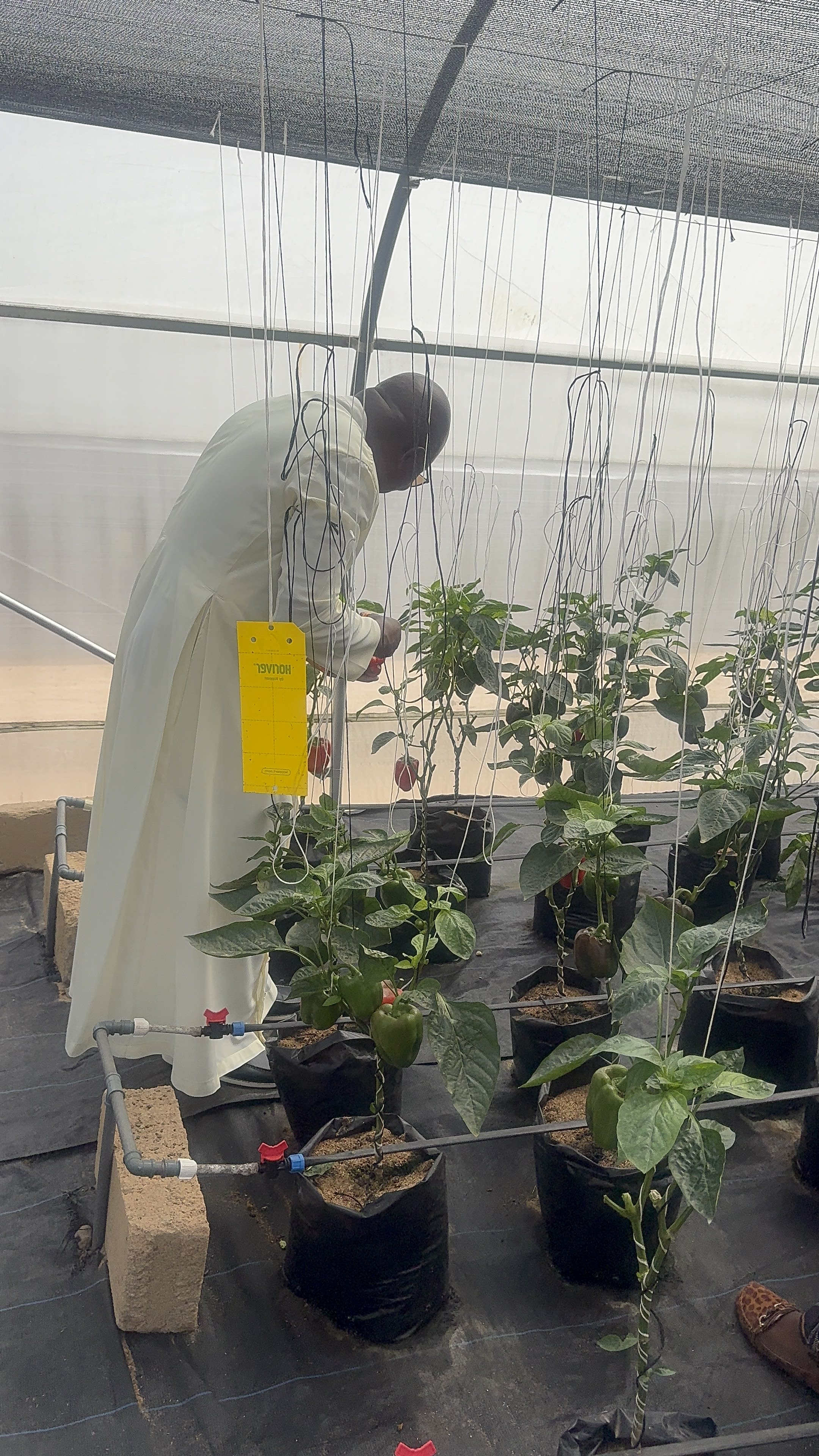
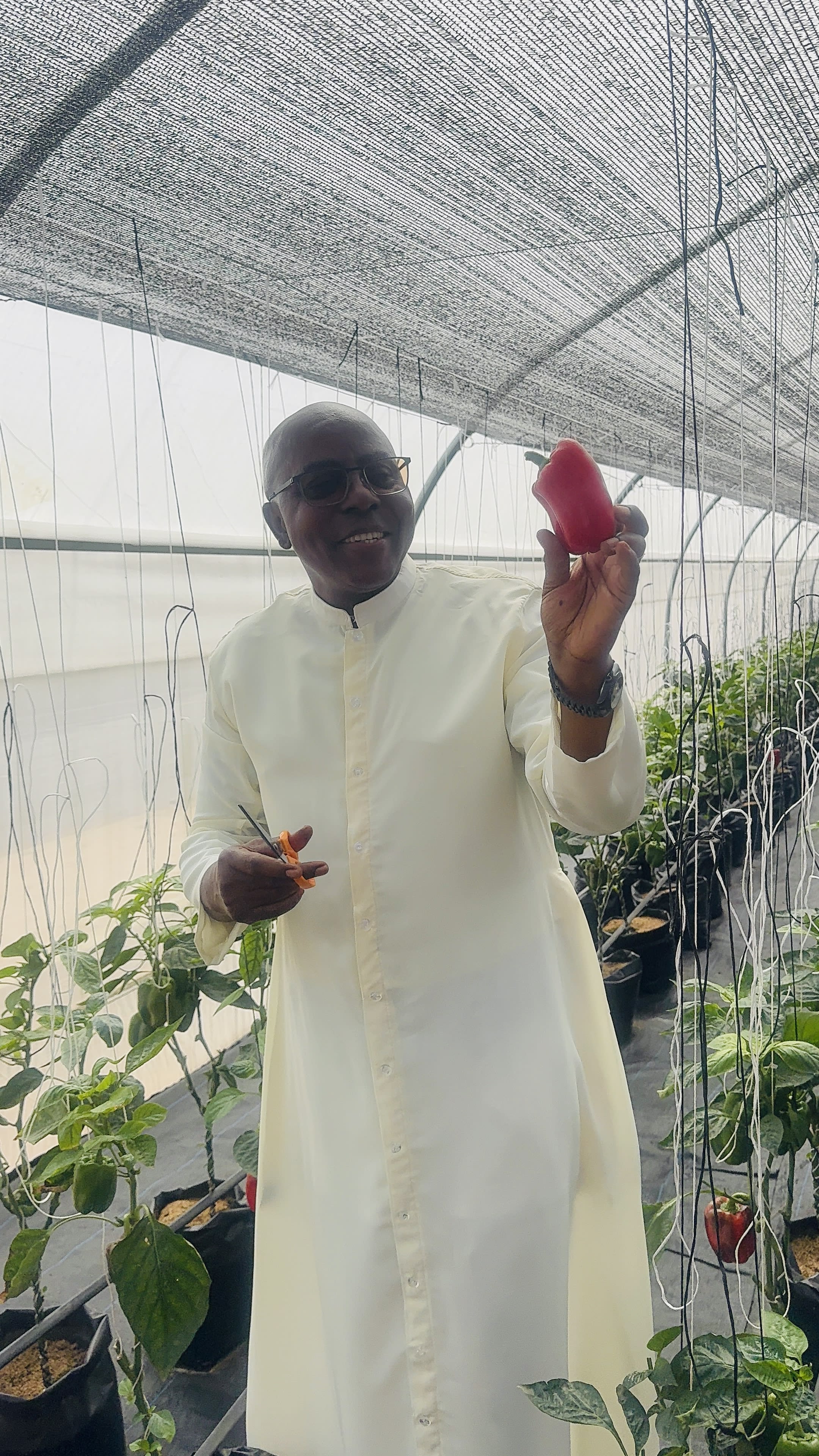
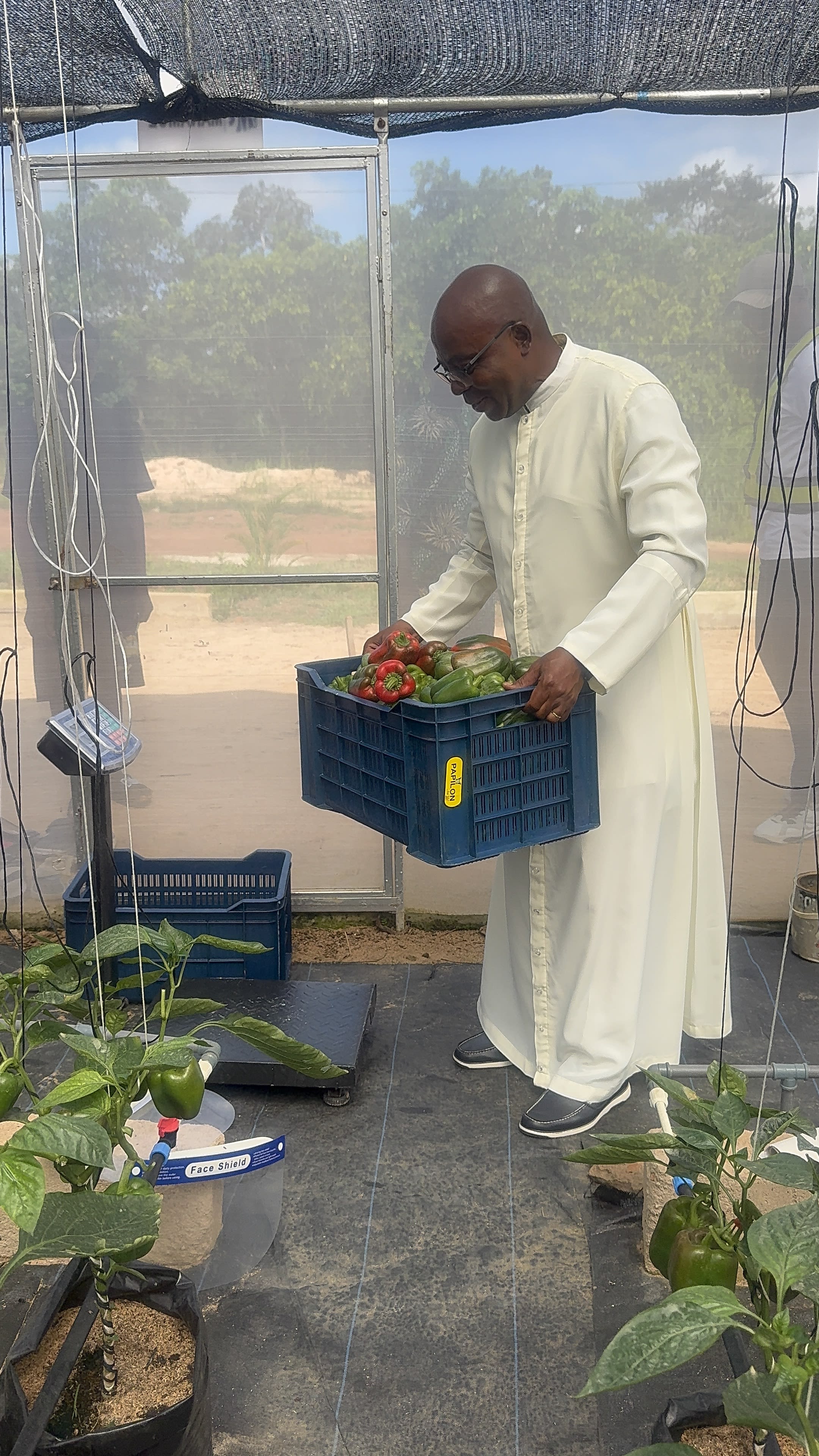
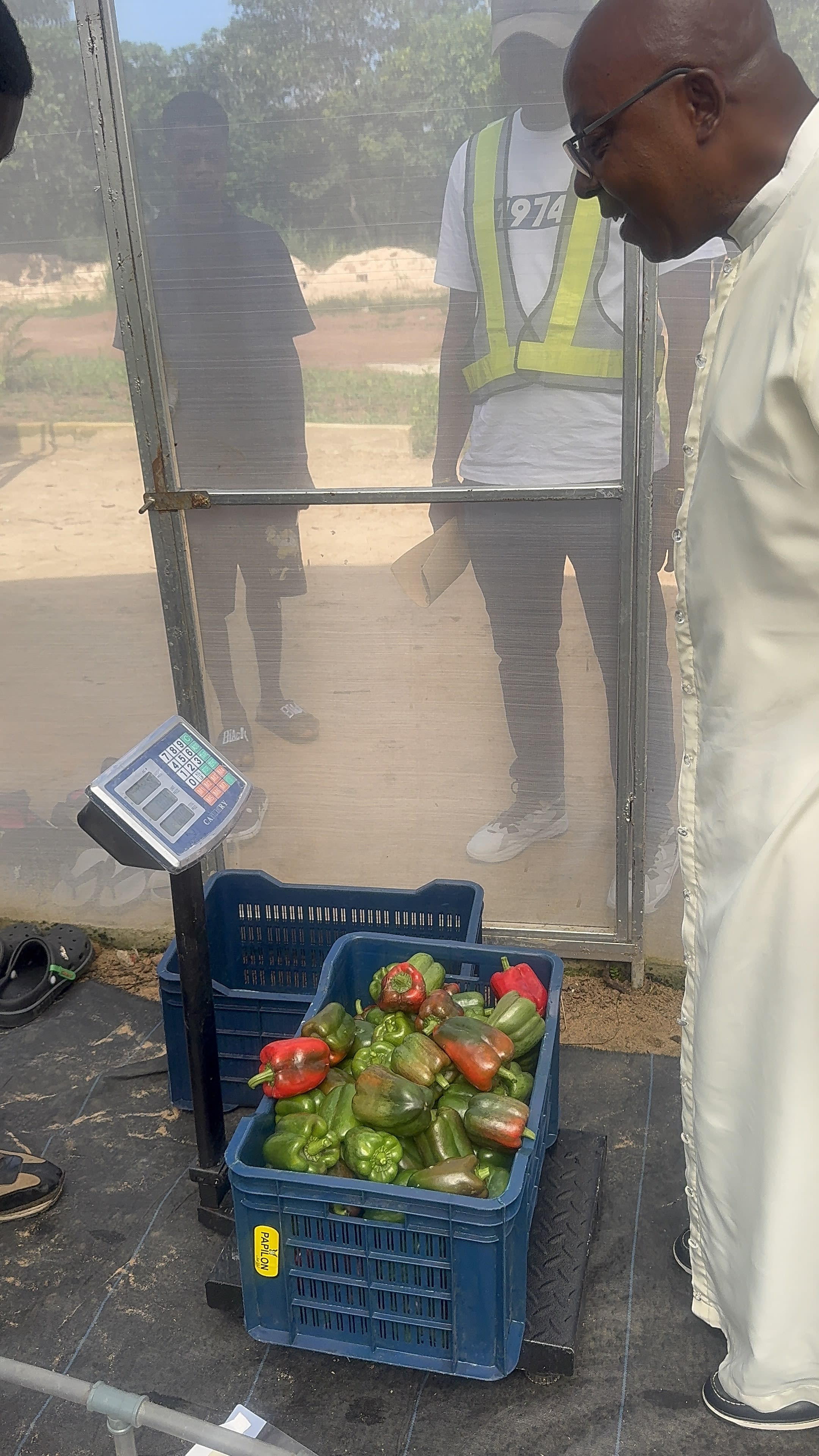
ENUGU STATE — Three months after work began on the first Research and Development Anchor Model at Godfrey Okoye University, the project has reached an important milestone: the first bell peppers have been harvested from one of its solar-irrigated greenhouse units.
This early harvest shows how practical agricultural research and modern greenhouse production can work together on campus. It also highlights how productive use of energy (PUE) solutions can support controlled-environment agriculture while giving students direct experience with technologies shaping today’s food systems.
A campus ecosystem for research and learning
The Research and Development Anchor Model brings together different growing environments. These include Manamuz’s naturally ventilated, solar-irrigated net greenhouses, which allow sunlight and air to circulate, and glasshouses equipped with PUE systems for temperature control.
The GO University facility is registered in the central Supply Chain Operating System (SCOS) under the ID achR&D1. The platform supports the facility’s connection to the wider Anchor Model and its digital coordination systems.
With different growing environments on one campus, students and researchers can study growing techniques, compare crop performance and gain practical experience with greenhouse systems, solar-powered irrigation and other scalable farming technologies. The model is designed to connect classroom learning with hands-on agricultural practice.
Connecting research, energy and production
The GO University Research and Development Anchor Model is part of a wider network of institutions contributing research, technical expertise and skills development to climate-smart agriculture.
- University of Nigeria (SEERG): The Sustainable Energy Engineering Research Group is leading research into phase change materials (PCM) to improve cold-room and cold-chain efficiency. The work also explores how energy savings from improved cold-chain performance could support the integration of electric vehicles (EVs) into the Anchor Model.
- Enugu State Polytechnic, Aguobu Iwollo: Contributes to human capital development. Its work supports skills development in greenhouse production, manufacturing, fabrication and installation; capabilities needed to build and maintain agricultural infrastructure locally.
- Federal College of Fisheries and Marine Technology (FCFMT), Ugbo: The collaboration explores ways to connect existing fish ponds, water resources, aquaculture infrastructure and production activities with greenhouse vegetable production and other climate-smart agricultural systems. This will provide a setting to demonstrate circular production approaches. FCFMT will also serve as a practical centre for research, demonstration, training and certification in integrated aquaculture and climate-smart agriculture.
GO University and FCFMT have each made a one-hectare site available to scale up and commercialise tested models within their institutions. These sites are intended to support research and production while creating opportunities for smallholder farmers within the institution and surrounding communities to learn from and benefit from the work.
Together, these institutional contributions connect crop production with cold-chain research, energy efficiency, electric mobility, aquaculture and workforce development.
A first harvest, with more to learn
The GO University Research and Development Anchor Model, registered in SCOS as achR&D1 and linked to the university’s Centre for Greenhouse and Post-Harvest Management Studies, is still being developed. Further work lies ahead, but this first bell pepper harvest is a meaningful step forward.
It demonstrates the potential of combining practical research, renewable energy and different controlled growing environments within a university setting. As the project develops, it will create further opportunities to study crop performance, strengthen research and expand practical training in greenhouse and post-harvest management.
The initiative is being advanced through a partnership between Manamuz and Godfrey Okoye University’s Centre for Greenhouse and Post-Harvest Management Studies, alongside international partners from Austria. We look forward to building on this milestone and deepening the impact of the collaboration.
Bringing the model to more schools
Research and Development Anchor Models can help schools create practical learning environments where students do more than study agricultural technologies in theory. They can take part in growing activities, observe crop development and explore how energy, infrastructure and farming practices work together.
The first harvest at Godfrey Okoye University marks the beginning of that journey. Manamuz can work with educational institutions to develop greenhouse and glasshouse facilities suited to their research, training, production and commercialisation goals.
Interested in establishing a Research and Development Anchor Model at your institution? Manamuz is ready to explore how a model can be designed around your institution’s priorities and resources.
#EnuguAnchorGreenhouseCluster
#ResearchAndDevelopment
#GreenhouseFarming
#SolarIrrigation
#PUE
#AgriculturalResearch
#ColdChain
#GodfreyOkoyeUniversity
#PostHarvestManagement