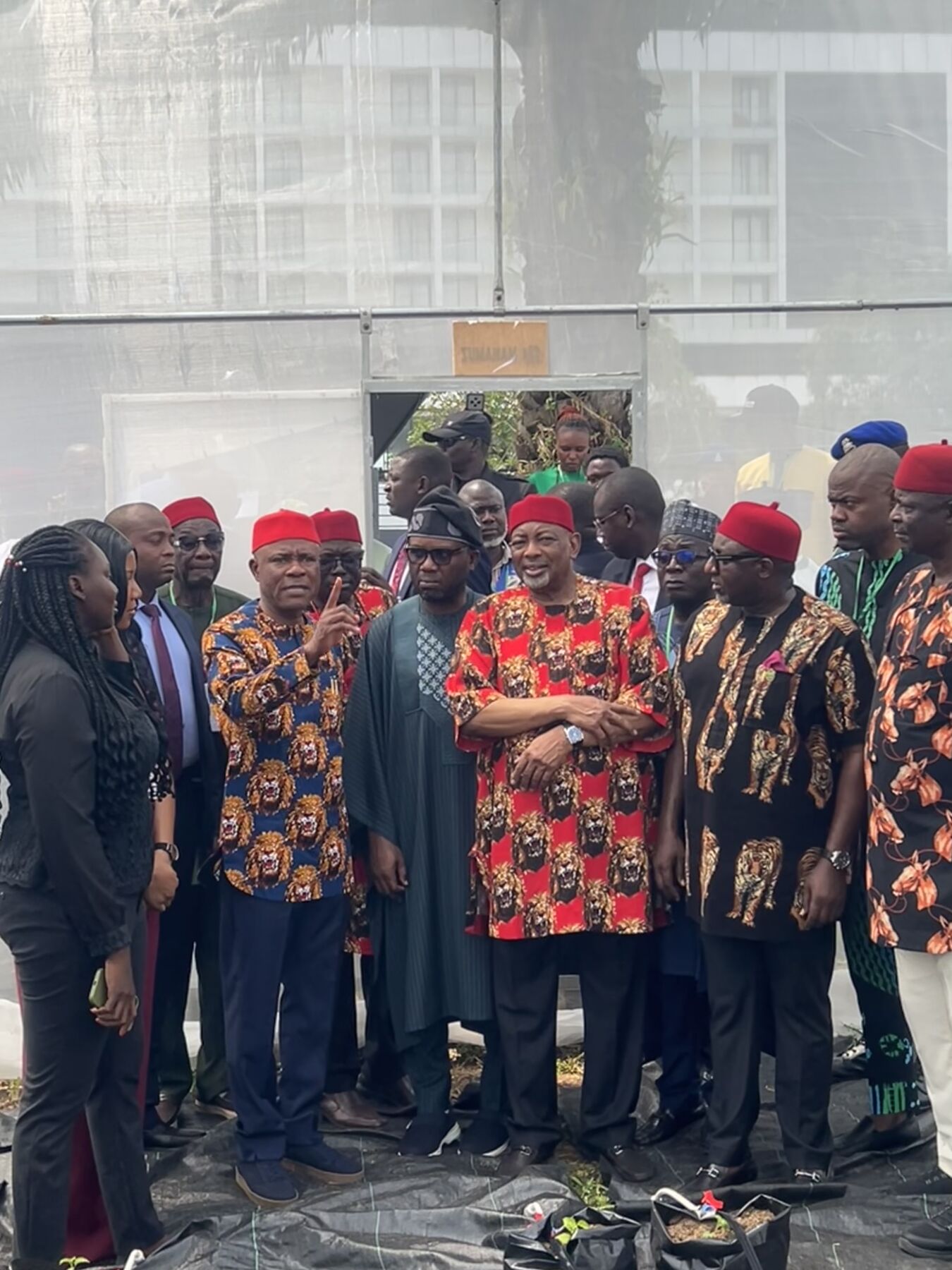
Inside the Manamuz greenhouse at NCAFS 2026. His Excellency, Governor Peter Ndubuisi Mbah, and Sen. Abubakar Kyari, CON, Nigeria's Minister of Agriculture and Food Security, tour the full-scale greenhouse assembled at the venue.
ENUGU, NIGERIA — Manamuz, a development partner of the Enugu State Ministry of Agriculture and Agro-Industrialisation, showcased the Enugu Anchor Greenhouse Cluster (EAGC) project at the 48th Regular Meeting of the National Council on Agriculture and Food Security (NCAFS 2026), held from 2–6 November 2026 at Hotel Presidential, Enugu.
The exhibition featured a three-dimensional (3D) demonstration of the project’s integrated agricultural ecosystem, alongside a full-scale, locally manufactured greenhouse assembled by Manamuz at the venue.
The display offered government officials, development partners, investors and other stakeholders a practical view of how climate-smart greenhouse production can be integrated into Enugu State’s 260 Ward Farm Estates initiative to strengthen local food production, reduce post-harvest losses, create employment opportunities and expand market access for smallholder farmers.
The Manamuz exhibition stand received visits from His Excellency, Dr. Peter Ndubuisi Mbah, Executive Governor of Enugu State; the Honourable Minister of Agriculture and Food Security, Senator Abubakar Kyari, CON; the Honourable Minister of Innovation, Science and Technology, Dr. Kingsley Tochukwu Udeh, SAN; and other senior government officials and stakeholders.
What visitors experienced: four connected elements of the EAGC model
At the centre of the exhibition was a 3D representation of the Enugu Anchor Greenhouse Cluster project’s four interconnected operational components:
- Climate-smart greenhouse farm clusters. Locally manufactured greenhouses designed to support year-round vegetable production through organised agricultural cooperatives, particularly those led by women, youths and persons with disabilities.
- Sustainable cold chain infrastructure. Solar-powered cold storage and post-harvest handling facilities designed to preserve the quality of fresh produce, reduce post-harvest losses and improve farmers’ access to reliable storage infrastructure.
- High-value market access. A coordinated fresh-produce aggregation, distribution and logistics network connecting greenhouse farmers to institutional buyers, urban markets and other commercial opportunities.
- Unified digital food supply operating system. An integrated digital platform for monitoring greenhouse operations, coordinating production, managing produce aggregation and providing visibility across the agricultural supply chain.
Together, these interconnected components demonstrate how agricultural production can be linked to reliable storage, efficient distribution, digital coordination and high-value markets within a unified food supply ecosystem.
Visitors also saw fresh yellow and red bell peppers harvested from Manamuz-supported greenhouses, providing tangible evidence of the agricultural produce being cultivated through the project.
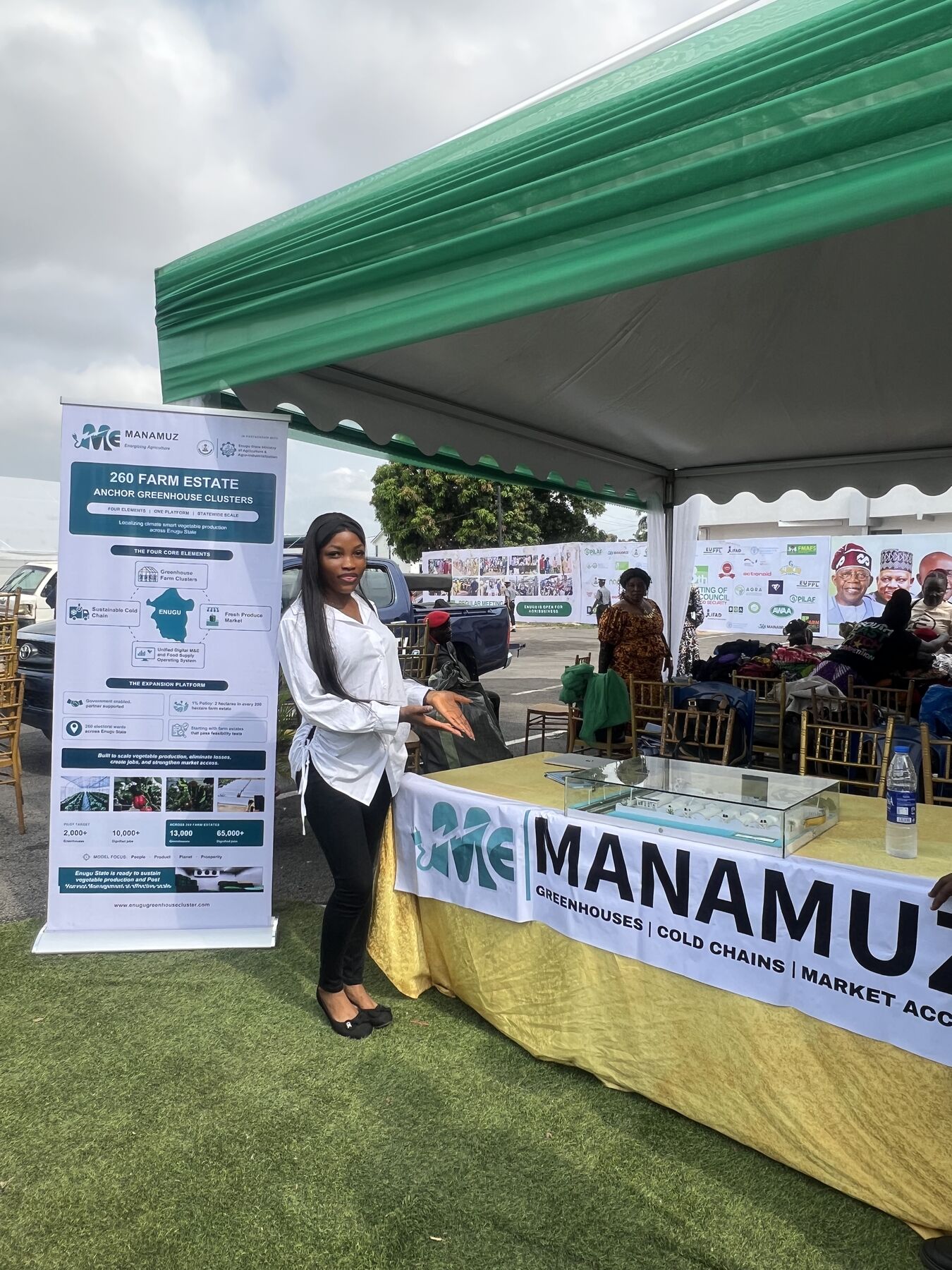

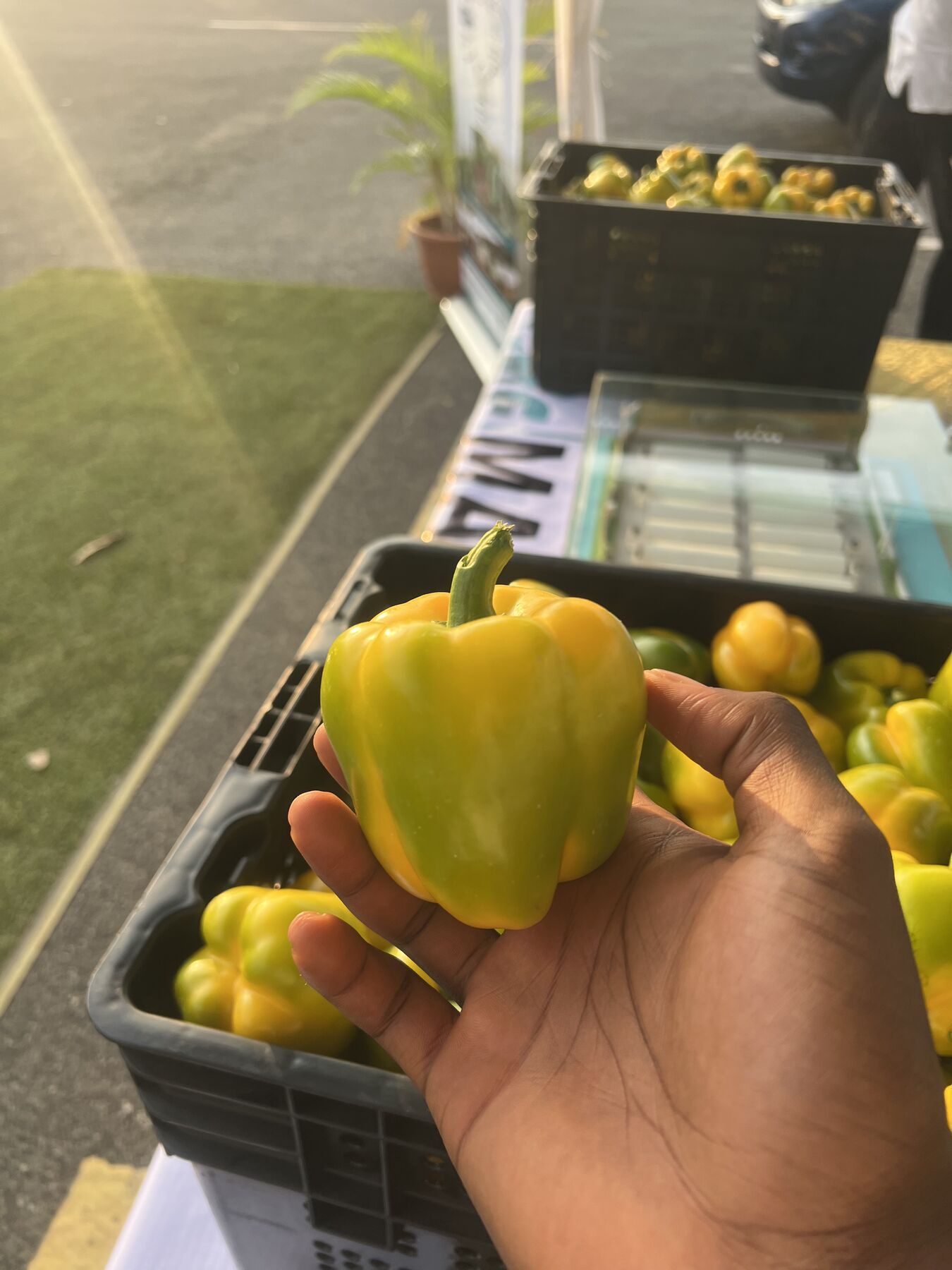
Integrating greenhouse clusters into Enugu State’s 260 Ward Farm Estates
A major highlight of the exhibition was the presentation of the proposed integration of greenhouse clusters into Enugu State’s 260 Ward Farm Estates initiative.
Under this approach, approximately 1% of each 200-hectare farm estate, equivalent to 2 hectares, is proposed to accommodate climate-smart greenhouse clusters and supporting infrastructure.
The Enugu Anchor Greenhouse Cluster project aims to scale its initial deployment target of over 2,000 greenhouses across the state, with the broader Ward Farm Estates framework providing an opportunity for further expansion.
- 2,000+
- greenhouses in the initial deployment target
- 13,000
- potential greenhouses across the 260 Ward Farm Estates
- 65,000
- projected direct and indirect jobs at full scale
At full-scale implementation, the proposed model envisions the potential deployment of up to 13,000 greenhouses across the 260 Ward Farm Estates, with a projected 65,000 direct and indirect employment opportunities across greenhouse production and associated agricultural value chains.
Beyond infrastructure deployment, the project promotes cooperative-based agricultural entrepreneurship, providing women, young people and persons with disabilities with structured opportunities to participate in commercially viable food production.
The programme also incorporates a lease-to-own financing approach designed to improve farmers’ access to productive greenhouse assets, reduce barriers to agricultural entrepreneurship and support long-term economic participation.
Advancing food security through partnerships and innovation
The exhibition aligned with the theme of NCAFS 2026:
“Enhancing Agricultural Value Chains, Agro-Industrialization and Market Access for Economic Growth.”
For the Enugu Anchor Greenhouse Cluster project, participation provided an opportunity to demonstrate how collaboration between government, private-sector innovators, development partners and farmer cooperatives can strengthen local food systems and accelerate the transition towards more productive, climate-resilient agriculture.
Through its partnership with the Enugu State Ministry of Agriculture and Agro-Industrialisation, Manamuz continues to advance an integrated approach that combines renewable energy, agricultural infrastructure, digital technologies and market connectivity.
The project also supports women, young people and persons with disabilities through the Energizing Women and Youths in Agri-Food Systems (EWAS) initiative.
EWAS focuses on expanding reliable and affordable access to green-energy-powered agricultural technologies, strengthening technical and entrepreneurial skills, promoting cooperative participation and creating productive economic opportunities within the agricultural value chain.
By integrating clean energy with productive agricultural infrastructure, the initiative seeks to empower participating farmers to increase productivity, reduce operational costs and build more sustainable livelihoods.
Building a climate-resilient agricultural future: from local production to global markets
The Enugu Anchor Greenhouse Cluster project represents a practical approach to advancing climate-resilient agriculture, improving local vegetable supply and connecting rural producers to growing urban and international markets.
During his visit to the Manamuz exhibition stand, His Excellency, Dr. Peter Ndubuisi Mbah, Executive Governor of Enugu State, reinforced the importance of building agricultural production capacity that can meet the food needs of Enugu State and the wider region while creating opportunities to connect local farmers to global markets.
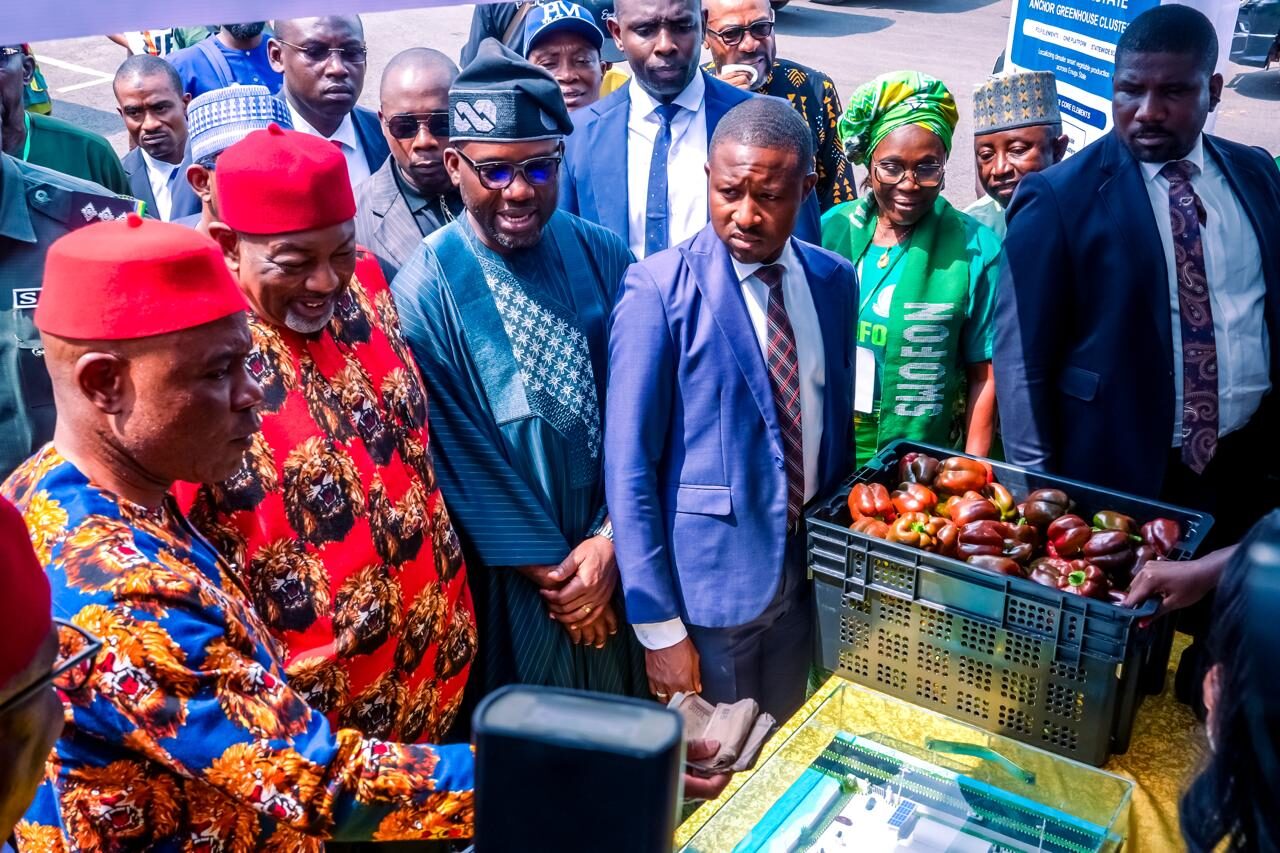
This vision is particularly significant in light of the recently announced expansion of Enugu Air’s international connectivity, including its planned London Gatwick service commencing on 10 December 2026, with four weekly flights.
The development presents a promising opportunity for Enugu State’s agricultural sector as the state strengthens its international connectivity and positions itself for greater participation in regional and global trade.
For the Enugu Anchor Greenhouse Cluster project, improved international connectivity reinforces the long-term vision of connecting organised greenhouse farmers to high-value markets beyond Nigeria.
Realising this opportunity will require continued investment in reliable cold-chain infrastructure, produce aggregation, quality assurance, export certification and logistics systems capable of meeting international market requirements.
By bringing greenhouse production, sustainable cold chains, digital coordination and market access into one connected ecosystem, the Enugu Anchor Greenhouse Cluster project seeks to create a pathway through which local farmers can produce more efficiently, preserve more of what they grow, meet domestic and regional food demand, and progressively access international markets.
The ambition is clear: to build a climate-resilient agricultural ecosystem that feeds local communities, strengthens regional food security and positions Enugu State as an emerging hub for high-value agricultural production and trade.
Learn more about the Enugu Anchor Greenhouse Cluster project and the EWAS initiative.